
Most hazards on an industrial site announce themselves eventually. A gas leak has a smell, or a hiss, or a reading on a monitor clipped to someone’s lapel. Gamma radiation gives you none of that. It has no odour, no colour and no taste, it passes straight through skin and clothing, and the only way anyone knows it is there is if an instrument tells them.
That single fact shapes everything about how gamma is managed. Where gas detection is often about spotting a change in the air you are standing in, radiation monitoring is about knowing where the source is, how strong it is, and how long you have been near it.
Gamma rays are high energy electromagnetic waves given off by the nucleus of an unstable atom as it decays. They sit at the far end of the spectrum, past X rays, and they carry enough energy to knock electrons off atoms they pass through. That is what the word ionising means, and it is why the biological effects matter. Ionisation inside living tissue can damage DNA.
Compared with the other decay products, gamma is the awkward one:
Because gamma travels so well, a source does not have to be near you to expose you. Distance and shielding do the work, not containment.
Very few people go looking for gamma. It tends to be part of a process that was already there.
Industrial radiography is the big one. Iridium 192 and cobalt 60 sources are used to shoot weld inspections on pipework and pressure vessels, often on shutdown work, often at night, often in the same plants that already run gas detection programmes. Nuclear medicine departments handle technetium 99m and similar isotopes daily. Nucleonic level and density gauges sit on vessels and conveyors across the cement, minerals and food industries. Well logging tools carry sources downhole. Scrap metal yards and metal recyclers screen incoming loads because orphaned sources do occasionally end up in a skip, and once a source goes into a furnace the contamination problem becomes very expensive.
Then there is naturally occurring background. Cosmic rays, potassium 40 in your own body, and radon and its decay products seeping out of the ground. Ireland has some of the higher indoor radon levels in Europe, driven by its granite and limestone geology, which is why radon testing sits alongside other workplace air monitoring here in a way it does not everywhere.
Three quantities come up constantly and get mixed up just as often.
Activity describes the source, not the person. It is measured in becquerels, one disintegration per second, and you will see it on source certificates and transport labels.
Absorbed dose is energy deposited per kilogram of tissue, measured in grays.
Equivalent and effective dose apply weighting factors to account for how damaging different radiation types are and how sensitive different organs are. This is measured in sieverts, and it is the number that regulations are written around. Practical readings are usually in microsieverts per hour.
For context, annual background in Ireland works out at roughly 4 mSv for an average person, with radon making up the largest share. Under the Ionising Radiations Regulations 2017 in the UK and the equivalent Irish regulations enforced by the EPA, the dose limit for a classified worker is 20 mSv per year, and 1 mSv per year for members of the public. Anyone who might exceed three tenths of a worker limit generally needs to be classified, monitored and under the supervision of a Radiation Protection Adviser.
There is no single gamma detector that suits every job, and the choice usually comes down to what question you are asking.
Geiger Muller tubes are the classic survey instrument. A gas filled tube, a high voltage across it, and an avalanche of current every time an ionising particle passes through. GM tubes are rugged, cheap, and they click, which matters more than it sounds. Operators trust an audible response. Their weakness is that they count events without telling you much about energy, so they are poor at identifying what isotope they are looking at, and they saturate in very strong fields.
Scintillation detectors use a crystal, typically sodium iodide doped with thallium, that emits a flash of light when gamma interacts with it. A photomultiplier turns that flash into a pulse, and the pulse height relates to the energy of the incoming photon. This makes scintillators far more sensitive than GM tubes and lets them do spectroscopy, so they can distinguish caesium 137 from cobalt 60 from a load of granite worktops. Portal monitors at scrap yards and ports are usually scintillation based.
Semiconductor detectors such as cadmium zinc telluride and high purity germanium give the sharpest energy resolution of all. Germanium needs cooling and tends to stay in laboratories. CZT works at room temperature and turns up in compact handheld identifiers used by emergency responders.
Dosimeters answer a different question. Rather than what is the dose rate here, they answer how much has this person accumulated. Passive film badges and thermoluminescent dosimeters are read periodically by a service provider. Electronic personal dosimeters give a live readout and alarm on rate and on cumulative dose, which is the sensible choice for anyone entering a radiography barrier.
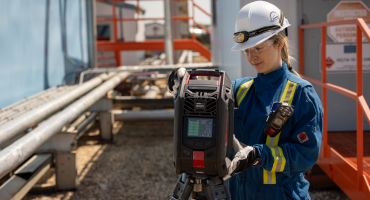
For teams doing broad hazard characterisation, some multi gas platforms can carry a gamma sensor alongside their gas channels. The MultiRAE is built this way, so a single instrument covers oxygen deficiency, flammables, toxics and VOCs on the same display and the same datalog; for gamma, the EXO8 area monitor is the solution. It is not a substitute for a dedicated survey meter in a radiography context, but for a confined space entry or an emergency response where nobody yet knows what they are dealing with, it removes a lot of guesswork.
Radiation protection comes back to the same three levers every time, and they are worth repeating because people reach for the third one first when the first two are cheaper.
Time. Dose accumulates linearly with exposure. Halve the time at the source, halve the dose. Planning the job on paper, or dry running it away from the source, is protection.
Distance. The inverse square law is generous here. Double the distance and the dose rate drops to a quarter. Remote handling tongs and a barrier tape line at the right radius do more than most PPE ever will.
Shielding. Lead, steel, concrete, water. Effective, but heavy, expensive and slow to put in place.
Everything sits under the ALARA principle: as low as reasonably achievable. Meeting the legal limit is the floor, not the target.
Radiation monitoring is not only a fixed-plant or shutdown concern. Some of the most demanding places to deploy connected area monitors are temporary, public and high-stakes, and that is increasingly where this technology turns up. When the Miami-Dade Fire Rescue Department prepared to protect up to a million fans across 2026 FIFA World Cup matches and festivities, it placed eight connected EXO area monitors discreetly around the host stadium to watch continuously for hazards, including gamma radiation. Four of those were EXO 8 units, each able to detect up to eight gases alongside gamma, backed by four G7 EXOs, all transmitting readings live over a cellular network.
In a venue like that the threat is rarely a single known source. Responders have to prepare for everything from accidental releases to deliberate chemical, biological and radiological incidents, and they need to know the moment anything changes. Feeding the monitors into a cloud platform gave incident commanders a real-time picture of conditions across the site, so rescue teams could respond quickly if a reading moved, and the same data could be shared across the agencies coordinating the event. The principle is the one that runs through this whole piece, just scaled up from a barrier around a radiography source to a stadium: know where a hazard could appear, monitor for it continuously, and get the data to the people making the decisions.
A few practical habits help:
A survey meter that has not been checked against a known source is an opinion, not a measurement. GM tubes lose gas and drift with age. Scintillator crystals yellow and their light output falls. Electronics wander with temperature and time. Instruments used for compliance need traceable calibration on a defined interval, usually annual, and a functional check before use.
The same discipline applies across the board. It is the reason bump testing and docking became standard practice on the gas side, and the logic transfers directly. A detector that has been sitting in a locker for six months and gets carried into a hazardous area without a check is doing nothing except making everyone feel better.
Gamma radiation is well understood, tightly regulated and, on most sites, entirely manageable. The risk is not really the physics. It is the assumption that because a hazard is invisible and uncommon, it belongs to someone else, usually the specialist contractor who turns up with their own kit and their own paperwork.
Sites that handle it well tend to be the ones that already handle gas detection well. Same instincts. Know where the hazard can appear, put a monitored barrier between it and people, check the instruments before you trust them, and keep the records so you can prove any of it afterwards.
If you are reviewing hazard monitoring across your site and want to talk through where the gaps sit, get in touch with the team at OBW Technologies.
From the Blog

If you have any questions about our products or services, please feel free to contact us.